Strategy workshop
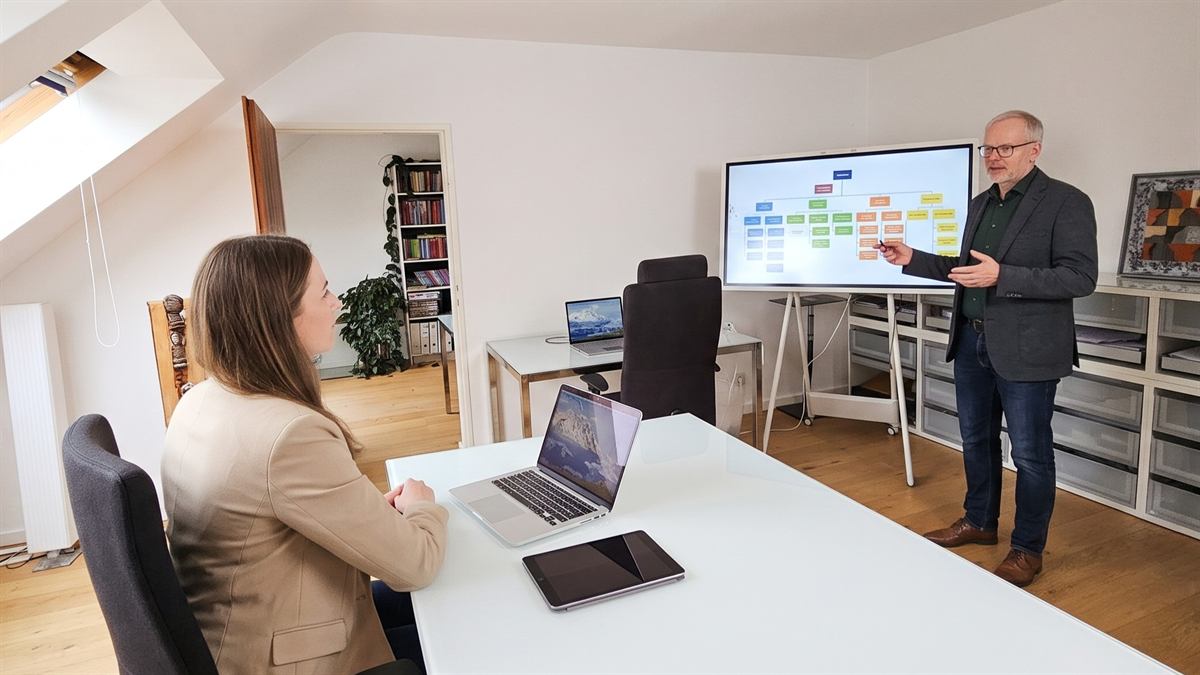
One or two days with the management team or the board: position, goals, priorities, measures. Facilitated, documented, with a binding result.
When an organisation grows, its friction grows with it. I work with you to develop strategy, structures and leadership further – as individual coaching, as a facilitated workshop or as support over several months. Office in Frankfurt am Main, support across Europe.
Almost every question that starts as a strategy question also has an organisational and a leadership side. Both belong on the table, otherwise the result will not hold.
No field can be moved on its own. Pulling on the strategy changes processes, roles and committees with it.
Many businesses work well and still do not know where they are heading. We first establish the position soberly – figures, customers, competition, capabilities – and derive goals from it that can actually be checked. Then comes the uncomfortable part: setting priorities and deciding what will no longer be done.
The result is not a slide deck but a short written strategy with goals, measures, responsibilities and milestones.
When decisions drag on, tasks are left undone or the same discussion returns every three months, the cause is rarely individual people. Usually roles are unclear, decision paths are too long or responsibilities overlap. We make the actual processes visible, name the points of friction and reorganise roles and decision rights.
The best specialist does not automatically become a good manager, and an experienced manager starts from scratch again in a new role. In systemic business coaching we work on concrete situations: a difficult conversation, a team in turmoil, the step from colleague to superior. I led international teams and ran profit centres myself for almost two decades – these questions are familiar to me from experience.
Associations and trade guilds have a particularity that consulting from industry often overlooks: decisions are made in committees, the work is carried jointly by paid staff and volunteers, and the members are client and target group at the same time. Typical concerns:
For small and medium-sized organisations AI has become a practical question rather than a visionary one. We approach it soberly: which activities in the house are text-heavy, recurring and not critical in terms of liability? That is where we begin, with a clearly defined use case, a measurement of the benefit and a rule about what is explicitly not fed into such systems. Only once one case holds does the next one follow.
Format follows concern. A structural problem is not solved by a talk, and a question of direction is not answered by a process analysis.
One or two days with the management team or the board: position, goals, priorities, measures. Facilitated, documented, with a binding result.
Interviews, figures and observation produce a picture of the actual processes – including the points where work gets stuck.
Clarify roles, improve collaboration, work through conflicts before they cost performance. Support over several sessions.
Systemic one-to-one coaching, confidential, built on concrete situations. For new and experienced managers.
Select use cases, test them, assess them and embed them in the team – with clear rules about what does not belong in such systems.
Impulses on strategy, leadership and organisation for general meetings, conferences and internal training – in English or German.
Transparent, verifiable and at your pace. After each step you decide whether and how it continues.
Clarify the concern, the goals and the framework – and whether we are a good fit.
Figures, market, processes and voices from inside the house produce a reliable picture.
Goals, measures and milestones – written, measurable and with named owners.
Support in workshops, coaching and working groups until it lands in daily business.
Measure results and adjust – including the assumptions we got wrong.
As a physicist with a doctorate I work as I would in the laboratory: state assumptions openly, test them against facts, then decide. In organisations this prevents measures that sound good and help nobody.
What managing directors and boards want to know before working together.
The first conversation is free of charge and without obligation. You then receive a written proposal with clearly outlined services and a time frame.
Then these pages fit better.
Write me a few lines about what it is about and who inside the organisation is involved. I usually reply within two working days.
Get in touch →